
RunSpace Training Sessions
We provide two stages of training, pre-competition sessions and the finalist bootcamp sessions, designed to help the teams prepare and engage with the industry, boosting their practical innovation skills. Whether you are a part of a cross-disciplinary team or have a background in space and satellite technologies, we welcome your participation!
Pre-Competition Training Sessions
Time Period:May
Target Audience:Teams interested in the space industry
-
Sessions一
[Webinar] May 11th | The New Space Economy: From Emerging Satellite Solutions to the Global Ecosystem
This exclusive webinar event brings together experts from ArkEdge Space, ArianeGroup, and Novaspace to explore the key intersection of technical breakthrough and commercial strategy.
📍Date & Time: May 11 (Mon), 13:40 - 17:45 (UTC+8).
📌Format: Webinar
🌟Fee & Audience: Free; open to all space enthusiasts.
🎤Language: English
🔗Sign up:https://ievents.iii.org.tw/EventS.aspx?t=0&id=3158
Finalist Boot Camp Training Sessions
Time Period:August
Target Audience:Competition finalist teams
Course Notes:
- All the training sessions are free of charge; however, seats are limited, and the Organizer reserves the right to review and approve the participant lists.
- The finalist teams are required to attend a minimum of 8 hours of the Finalist Boot Camp Training and networking activities (including both online and in-person sessions) and must be present for the Final Review and Awards Ceremony & Demonstration Day.
- The Organizer reserves the right to modify or cancel any aspects of the training sessions.
Competition FAQ
-
Q1
I’m interested in joining the competition, but I’m not sure about the proposal direction and I don’t have a team yet. What should I do?
Don’t worry! You can enhance your industry knowledge by participating in our Pre-competition Training sessions held in May. For more information about the event, please refer to the "Latest News" section on the website.
If you’re looking for teammates, feel free to email the Organizing Team. We can help match you with other participants who have similar needs and help you form a team. -
Q2
Can I reveal my team’s, identity, or affiliated organization in the submission documents?
No. To ensure absolute fairness, no information regarding the team or advisors—including names, affiliated organizations, photos, or logos—may appear in any submission documents. This applies to the project title, team name, proposal content, videos, and the work itself. Any violation will result in disqualification.
-
Q3
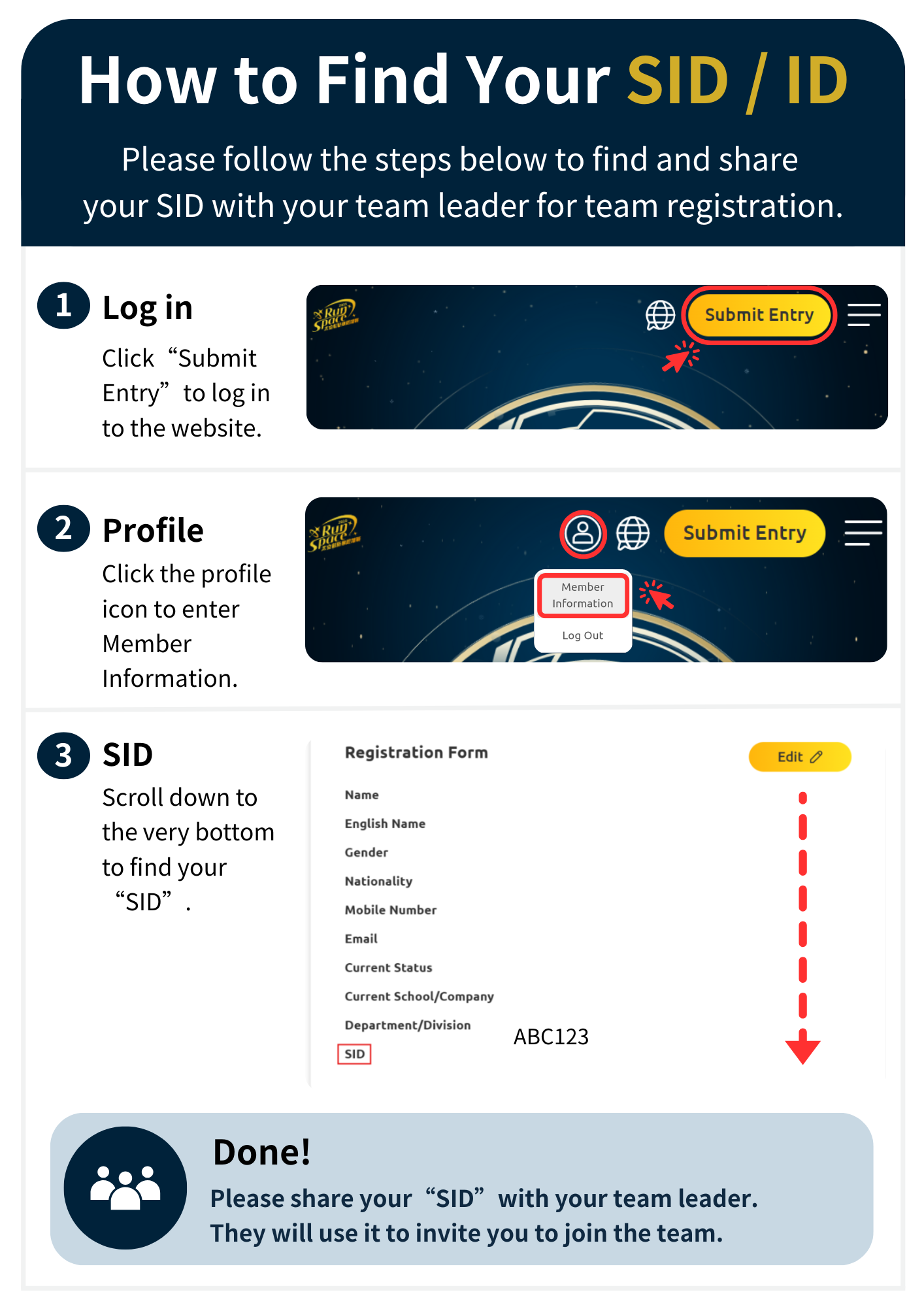
How can the team leader add members to the team? Where can members find their Personal ID (Personal SID)?
To successfully build your team, the team leader will need to enter each member's "SID" during the registration process. Please kindly ask your team members to log into the official website to retrieve this unique ID and share it with the leader to complete the team formation smoothly!
To find your Personal ID, log into the RunSpace official website, click on the profile icon (avatar shape) in the top right corner, and select Member Information from the dropdown menu. Once on the personal profile page, scroll down to the very bottom to locate and copy your " SID" for the team leader to use for team assembly.
-
Q4
Can I modify my project after it has been submitted?
Yes! Teams can log back into the registration page to adjust team data or modify files as many times as needed before the deadline on June 30th, 2026, at 1:00 PM (UTC+8). Once the deadline passes, no corrections or replacements—including team member lists or uploaded files—will be permitted. The system will use the latest submission as the final version.
-
Q5
Since English is the primary language for the competition, do the registration details also need to be filled out in English?
Yes. To facilitate backend data and statistical processing, please ensure all information is provided in English during the registration process.
-
Q6
With the various training courses provided, what is the minimum requirement for shortlisted participants?
Each shortlisted participant is required to complete at least 8 hours of training. Both in-person and online sessions are counted toward this total.
-
Q7
What should I keep in mind regarding the collection of prize money or finalist stipends?
Once a team has registered, they must complete the competition (including participation in the Preliminary/Final Review). Withdrawal is not permitted. If a team needs to withdraw, the Organizer have the right to cancel or withhold participation certificates, finalist certificates, and any related awards, prizes, or trophies.
As this competition is organized by the Taiwan government, legal procedures require the recipient to provide a physical (hard copy) receipt for verification. Teams must mail the signed paper receipt to the Organizing Team's office. Please ensure that the correct physical receipt reaches us by August 31st. We strongly advise international teams to factor in shipping time and to confirm the receipt’s details with our staff via email before mailing it out.
-
Q8
How can I contact the Organizing Team if I have questions during the competition?
In addition to our official customer service email, you can join the Official Line account for real-time messages and calls. If your team requires contact via WhatsApp, please email us, our staff member will reach out to you.
-
Q9
Will the organizer provide presentation materials or recordings from the online briefing session?
Yes, Please find the "Competition Overview" in the Latest News" section (Click here).
-
Q10
SST Guideline🌔 | Where can I find detailed reference materials for the Sponsor Special Topic?
ispace has provided a comprehensive mission briefing. Participants are welcome to log in to the official website and click the “Document Download Section” under the “Participant Section” tab to access the reference documents. Additionally, ispace has prepared a thorough video explaining the scope, project scale, and core conceptual expectations for the “Micromissions for the Moon”. Please watch this video under the "Latest News" section (Click here).
-
Q11
SST Guideline🌔How many teams will be selected as finalist teams for the Sponsor Special Topic?
Based on previous SST editions , approximately 5 to 10 teams are typically selected as shortlisted. However, please note that the final number of shortlisted teams will be determined by the enterprise judging panel, depending on the total numbers and quality of the submissions received.
-
Q12
SST Guideline🌔Would proposals that serve multiple mission objectives be viewed more favorably than single-objective proposals?
Generally, yes. While projects with purely scientific value are highly important, our judging panel will look more favorably upon proposals that successfully address multiple objectives. Adding a commercial or industrial dimension—such as demonstrating how scientific research applies to In-Situ Resource Utilization (ISRU)—will significantly increase the overall impact and value of your mission.
Submission Guideline: It will fascinate the judge panel if you enhance the overall value of the proposal by incorporating multiple mission objectives, specifically aligning scientific research with commercial, industrial, or practical applications to maximize impact. -
Q13
SST Guideline🌔Would proposals involving local government or industry collaboration be viewed more favorably, and is emphasizing Taiwan-specific industrial advantages necessary?
Integrating local partnerships is highly valued as a key criterion for demonstrating the real-world feasibility of your proposal. While it is not strictly mandatory, showing how your project aligns with the priorities of organizations like the Taiwan Space Agency (TASA) or local industrial partners strongly highlights your ability to move an innovative idea from concept to execution.
Submission Guideline: It will be an advantage to demonstrate project viability and real-world impact by actively aligning the proposal with local industrial strengths, governmental priorities, or institutional collaborations.
-
Q14
SST Guideline🌔Regarding the prize of the Sponsor Special Topic, during the visit to the Tokyo headquarters, will there be opportunities to learn about the business development and marketing aspects of the space industry?
Yes, absolutely! We are excited to provide a comprehensive experience that covers both technical and commercial insights. You will engage with our Business Development team to explore the "Lunar Economy"—including resource mining, biopharmaceuticals, and semiconductor manufacturing—alongside technical sessions with our engineers to discuss the fascinating challenges of lunar hardware.Our goal is for participants to understand the moon as the next frontier for industrialization and to spark discussions on a lunar roadmap for Taiwan. Technical sessions with engineers regarding the challenges of lunar hardware will also be part of the experience.
-
Q15
SST Guideline🌔Are detailed diagrams or complex calculations required for the payload description in the presentation?
While including detailed diagrams or physical calculations is considered a plus, it is not mandatory. Lunar missions are highly complex, and technical details (such as circuit designs) typically require multiple iterations to finalize. Therefore, participants are not expected to have every technical detail fully resolved at this stage.
Submission Guideline: ispace will primarily focus on the maturity of your core idea, the clarity of the product's functions, and the specific problems it solves. If you face time or page constraints, we recommend prioritizing a clear and compelling conceptual explanation over complex technical data.
-
Q16
SST Guideline🌔Will teams need to provide estimated data transmission and bandwidth requirements in their proposals?
Providing data transmission and bandwidth estimates is not mandatory, but including these projections will certainly be considered a significant plus in the evaluation. We understand that exact data volumes are difficult to predict at this early stage, so please don't let this constrain your creativity.
Submission Guideline: Focus primarily on the innovation and hardware design of your concept. Include data projections if they are available, keeping in mind that the preferred operational model utilizes local caching rather than continuous live streaming.
-
Q17
SST Guideline🌔Will participants need to include their own battery systems in their concepts?
The necessity of an independent power system depends entirely on your design. If your hardware remains physically attached to the lander—such as integrated cameras or sensors—we will gladly provide the necessary power and data transmission support through the lander's infrastructure. However, if your proposal involves deploying an independent unit like a satellite or rover, your payload will need its own power source and wireless communication capabilities.
Submission Guideline: Clarify whether the payload remains attached to the lander or operates independently. For independent units, ensure the proposal explicitly accounts for an autonomous power source and wireless communication capabilities.
-
Q18
SST Guideline🌔Does the 5kg limit apply only to the payload, or to the total system weight?
The 5kg weight limit encompasses the entire system, meaning everything included in your proposal must stay within this specified range. To ensure your payload can be comfortably accommodated within the 8U dimensions, we highly recommend aiming for an ideal total system weight of approximately 4kg.
Submission Guideline: Design the entire system to strictly remain under the 5kg threshold, ideally optimizing toward a 4kg target to ensure smooth physical integration within the 8U dimensions.
-
Q19
SST Guideline🌔What are the required specifications and recommendations for hardware design and material selection?
Proposals must strictly adhere to our physical constraints: the payload must fit within an 8U volume and maintain a total mass between 4kg and 5kg. To help us understand the feasibility of your brilliant designs, we look forward to seeing your material selection and structural layouts.
Submission Guideline: Adhere strictly to the 8U volume and 4-5kg mass constraints. Provide a clear structural diagram illustrating component layout and specify intended lightweight materials, such as carbon fiber, to demonstrate mass optimization and structural feasibility.
Declarations
The Organizer's Rights and Related Matters
- If a participating team submits late, loses, incomplete, non-compliant or illegible work, the Organizer and Executive will consider it invalid, and no further notifications will be provided. They will also not assume any responsibility.
- Unless the participant can prove that they have exercised due diligence, they must properly safeguard any information related to the Organizer, Executive, and competition’s cooperating partners that they become aware of or possess as a result of this competition. Without written consent from the Organizer, they may not disclose or deliver any such information to third parties.
- All nominations and awards will be determined by the judges based on the standard of the entries. If necessary, the number of the awards may be adjusted in case there is no winner, and the judging panel may change the names of the awards. To maintain the fairness of the competition and scoring requirements, the Organizer has the right to request the detailed original design documents from the teams that advance to the finals and the winning teams.
- The participants agree that the Organizer and Executive may include their personal data and related works entered for the competition in the RunSpace Innovation Challenge talent matching database.
- The finalists and the awardees must participate in the related events, publicity, and media interviews for up to five years.
- Upon the announcement of award recipients, the Executive will compile and publish summaries of the winning and finalist entries, along with relevant competition results for public display. Participating teams are required to provide necessary materials within the specified timeframe. If a team fails to submit the required materials on time, the Executive reserves the right to use the materials submitted during the competition period (such as application forms, application documents, presentation files, or videos) to compile and publish related content.
- During the execution of the competition, online and offline events will be held periodically, including competition briefings, pre-competition training, finalist boot camp training, networking activities, awards ceremonies, and achievement exhibitions. These events will be recorded and photographed, and all images and footage may be used by the Organizer and Executive for future promotional activities, publication on the competition official website, and documentation purposes. Participation in these events constitutes consent to be filmed and for the recorded images and videos to be used accordingly.
- The participants must guarantee that all the materials and documents submitted are true and do not infringe on the rights of others (including the intellectual property rights). In the case of falsehood or infringement of others’ rights, the Organizer has the right to revoke the participant’s competition or award eligibility and to reclaim any prize money, trophies, or certificates. The participants agree to bear all the legal liability (such as intellectual property disputes or lawsuits).
- If a team’s entry involves research and developmental resources or intellectual property rights from companies, universities, or faculty, the team must obtain consent from the relevant entities or individuals before registering for the competition. If there are concerns or disputes arising from the entry that prevent the disclosure of the entry’s information, the team will be disqualified from being shortlisted or awarded an award, and the next-ranked team will be selected as their replacement.
- In cases where an entry infringes on others’ intellectual property rights or violates other competition rules, the judging committee will arbitrate, and the participants may not contest the arbitration results.
- The intellectual property rights of the entries will not belong to the Organizer. To promote this event, the participants agree to grant the Organizer a permanent license to reproduce, publish, or present the work in all activities related to the event. The Organizer has the right to compile the entry into any form of an album for non-profit promotional purposes, and the participants commit not to exercise their intellectual property rights against the Organizer.
- If the participants wish to apply for a patent for their entry, they should submit their application to the intellectual property application authorities before the competition to avoid losing the novelty because of the public disclosure of their work during the competition. Given the international nature of the competition, relevant intellectual property authorities include, but are not limited to, the Taiwan Intellectual Property Office. (Teams participating in the Sponsor Special Topic must obtain written consent from the sponsoring company before applying for patents, trademarks, or other intellectual property registrations, and shall not take any actions that may restrict the rights of the sponsoring company.)
- Licensing arrangements for outcomes generated through collaboration with partner companies (such as sponsoring companies) in this competition shall be negotiated between participating teams and partner companies in accordance with applicable laws.
- Participation indicates agreeing to abide by these competition rules and acceptance of the Organizer’s and judges’ final decisions. The Organizer reserves the right to amend these rules.
- If a participant violates the rules of the competition or other relevant regulations, the Organizer has the right to cancel the participant’s or their team’s eligibility to compete or win.
- The participants agree to waive any legal claims against the Organizer, Executive, and other competition cooperating parties arising out of the competition.
- The Organizer reserves the right to amend these competition rules in relation to any matters not explicitly covered.